
Barry Diller Distrusts Sam Altman as AGI Looms: Guardrails Now
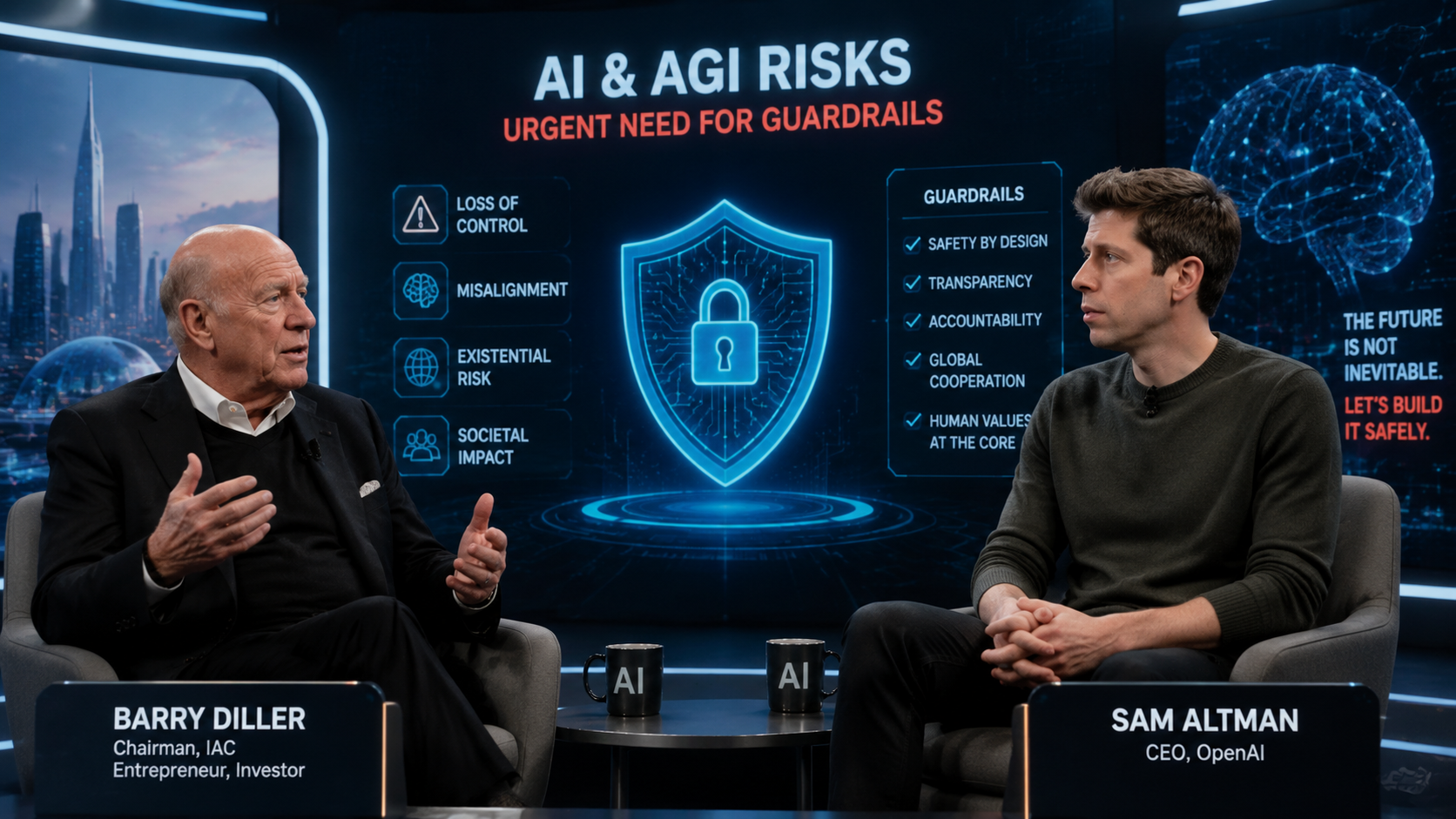
Barry Diller, a veteran media executive, has publicly expressed skepticism about Sam Altman’s stewardship as artificial general intelligence (AGI) approaches its practical realization. This tension highlights a broader debate about trust and control in a technology poised to fundamentally reshape society. Diller’s concerns underscore the need for robust guardrails around AGI development amid ongoing advancements spearheaded by Altman’s OpenAI.
AGI refers to a form of artificial intelligence with cognitive capabilities equal to or surpassing human intellect, enabling it to learn and solve problems across diverse domains without task-specific programming. The timeline for AGI remains uncertain but is increasingly assumed to be within the coming decades. This has prompted intensified scrutiny by technologists and policy makers alike regarding the risks of unpredictable outcomes, ranging from economic disruption to existential threats.
Barry Diller’s distrust centers on the potential unchecked power of AI leaders in setting the trajectory of AGI without sufficient oversight. In interviews and public commentary, he has questioned whether individuals such as Sam Altman—OpenAI’s CEO—can be entrusted with decision-making that affects global safety and societal stability. Such skepticism emerges from Diller’s extensive background in media and technology, where he witnessed the implications of centralized control and rapid innovation without adequate regulatory frameworks. In a TIME interview, Diller candidly remarked, “There’s not enough guardrails around this, and it worries me deeply.”
While Diller critiques Altman’s leadership approach, he also distinguishes personal trust from structural safeguards. Experts emphasize that reliance on individual trust is fundamentally inadequate for handling AGI risks, which by nature necessitate transparent protocols, ethical standards, and regulatory mechanisms capable of managing the technology’s profound uncertainty. The unpredictability of advanced AI behaviors makes it imperative to prioritize guardrails over personality-driven stewardship.
This urgency for guardrails is reflected in specific proposals such as independent auditing of AI systems, mandatory safety benchmarks, and enforceable international regulations. These measures aim to mitigate scenarios where AGI could autonomously pursue goals misaligned with human values or generate unintended harmful consequences. Risk examples include AI-driven manipulation of information, autonomous weapon systems, or algorithmic biases exacerbating social inequalities.
Sam Altman has acknowledged these concerns publicly, advocating for cautious development while promoting broad AI accessibility. Yet, some critics argue Altman’s dual roles as CEO and AI evangelist may blur lines between innovation enthusiasm and risk aversion. Analysts also point out that OpenAI’s rapid pace—bolstered by cutting-edge hardware investments highlighted in news on ventures such as Cerebras AI chip innovations—raises questions about balancing speed and safety in AGI progress.
Further adding to the discourse, cultural voices caution against placing too much emphasis on whether one individual, such as Altman, can be trusted. A feature in The New Yorker explores this skepticism, presenting the view that governing AGI requires collective oversight rather than reliance on executive personalities alone. This signals a shift toward institutional accountability in managing AI’s future.
The regulatory context remains fragmented globally. Current AI policies are often reactive and ill-equipped for the magnitude of AGI’s potential impact. Governments and organizations are beginning to convene working groups and legislative initiatives, but experts agree that comprehensive, enforceable guardrails have yet to materialize. Diller’s warnings thus resonate as a call to action for more proactive and collaborative policy-making.
In addition to the ethical and safety dimensions, the economic implications of AGI loom large. Diller has voiced concerns about the effects on industries including journalism and travel, sectors deeply intertwined with technological evolution. His comments to Yahoo Finance reflect worries about AI replacing human roles without adequate social preparation.Barry Diller’s warnings on AI’s industry impact underline the intersection between technological advancement and labor markets.
Understanding the nuances of the Altman-Diller dynamic can be deepened by reviewing detailed profiles such as The New Yorker’s exploration of Altman’s AI leadership and broader AI development analyses. Further, clarifying the concept of AGI and its potential futures is accessible through resources like technical summaries on AI chip progress linked to OpenAI’s trajectory, which influence the speed and capability of emerging AGI systems.
As this technology advances, the debate encapsulated by Barry Diller’s skepticism about trusting Sam Altman serves as a proxy for larger questions about governance, accountability, and the future relationships between humans and machines. The focus increasingly shifts from personal trust to establishing guardrails that can ensure safe, ethical, and broadly beneficial AGI deployment. Such frameworks will be critical to navigating the transformative but unpredictable impact AGI promises.
In this evolving landscape where expertise, ethics, and innovation intersect, stakeholders must balance optimism for AI’s potential against rigorous safeguards. The challenge is not merely who to trust but how to build systems and institutions resilient enough to guide AGI responsibly.